Top 7 Areas with Most Expensive Council Tax in UK 2025
Discover why Rutland, Nottingham, and others have the most expensive council tax in UK for 2025. Find out what it means for residents and property owners.


Council tax is an unavoidable annual expense for homeowners and tenants across the United Kingdom, yet the amount levied can differ dramatically from one local authority to another. This variation isn't solely linked to property value; it reflects a complex interplay of local government funding, the cost of delivering essential services, and unique regional demographics. It creates what many describe as a "postcode lottery," where seemingly similar properties in different areas face vastly different annual charges. While many assume London boroughs carry the heaviest burden, data reveals that some of the highest rates are found in rural counties and specific urban centres outside the capital.
This article cuts through the complexity to provide a clear, data-driven breakdown of the areas with the most expensive council tax in the UK. Using official government figures and property market analysis, we will explore the specific councils that charge the highest rates for a Band D property, the standard benchmark for comparison. For each area on our list, from Rutland to Dorset, we will examine the underlying factors driving these high costs, such as social care demands or sparse population density. This definitive guide offers crucial, actionable insights for homebuyers calculating affordability, investors assessing rental yields, and residents seeking to understand their local financial landscape.
1. Rutland County Council
Topping the list of the most expensive council tax in UK is Rutland County Council. This small, landlocked county in the East Midlands consistently requires its residents to pay the highest rates in England. For the 2024-25 financial year, the average Band D council tax bill in Rutland was a significant £2,543, a figure that underscores the unique financial pressures faced by England's smallest historic county.

The primary reason for these high charges is a matter of scale. With a population of only around 41,000 according to ONS estimates, Rutland has a very small tax base from which to fund a full suite of essential services, including adult social care, road maintenance, and waste collection. Unlike larger authorities that benefit from economies of scale, Rutland must fund these services for a sparse, rural population, which increases delivery costs per household. Despite its high property values, with the Land Registry showing an average house price over £380,000, the limited number of dwellings means each household must contribute a larger share to meet the council's budget.
Why Is Rutland’s Council Tax So High?
Rutland's status as an independent unitary authority is a key factor. While there have been pressures to merge with larger neighbouring councils like Leicestershire, Rutland has fiercely maintained its independence. This decision, while preserving local identity, means it cannot spread administrative and service costs across a larger population.
To mitigate these financial challenges, the council has implemented innovative cost-saving measures. For example, it engages in shared services arrangements with neighbouring authorities for functions like public health and transport. Furthermore, community-led initiatives, such as volunteer transport schemes, play a vital role in reducing the financial burden on the council while ensuring residents receive necessary support.
Actionable Tips for Rutland Residents
If you are a resident or potential homebuyer in Rutland, it is crucial to budget for this significant expense. However, several strategies can help manage or reduce your bill:
- Check Your Banding: Use the Valuation Office Agency (VOA) website to ensure your property is in the correct council tax band. An incorrect banding could be costing you hundreds of pounds a year.
- Apply for Discounts: A 25% single person discount is available if you live alone. Discounts are also available for students, individuals with severe mental impairments, and live-in carers.
- Explore Council Tax Support: If you are on a low income or claim benefits, you may be eligible for the Council Tax Support scheme, which can reduce your bill significantly, sometimes by up to 100%.
- Spread the Cost: Opt to pay your bill over 12 months instead of the standard 10. While this doesn't reduce the total amount, it makes monthly payments more manageable.
While Rutland presents the highest council tax burden, it is interesting to see how it contrasts with the lowest. For a full comparison, you can explore our analysis of the cheapest council tax areas in the UK.
2. Nottingham City Council
Ranking highly among the most expensive council tax in UK urban areas is Nottingham City Council. This major city authority in the East Midlands is notable for its high charges, with the average Band D bill for the 2024-25 financial year reaching £2,536. As a unitary authority responsible for a dense, diverse urban population of over 328,000, Nottingham faces intense and costly demands for its services.
The following chart illustrates the relationship between Nottingham's high council tax rate, its total population, and its significant student population.
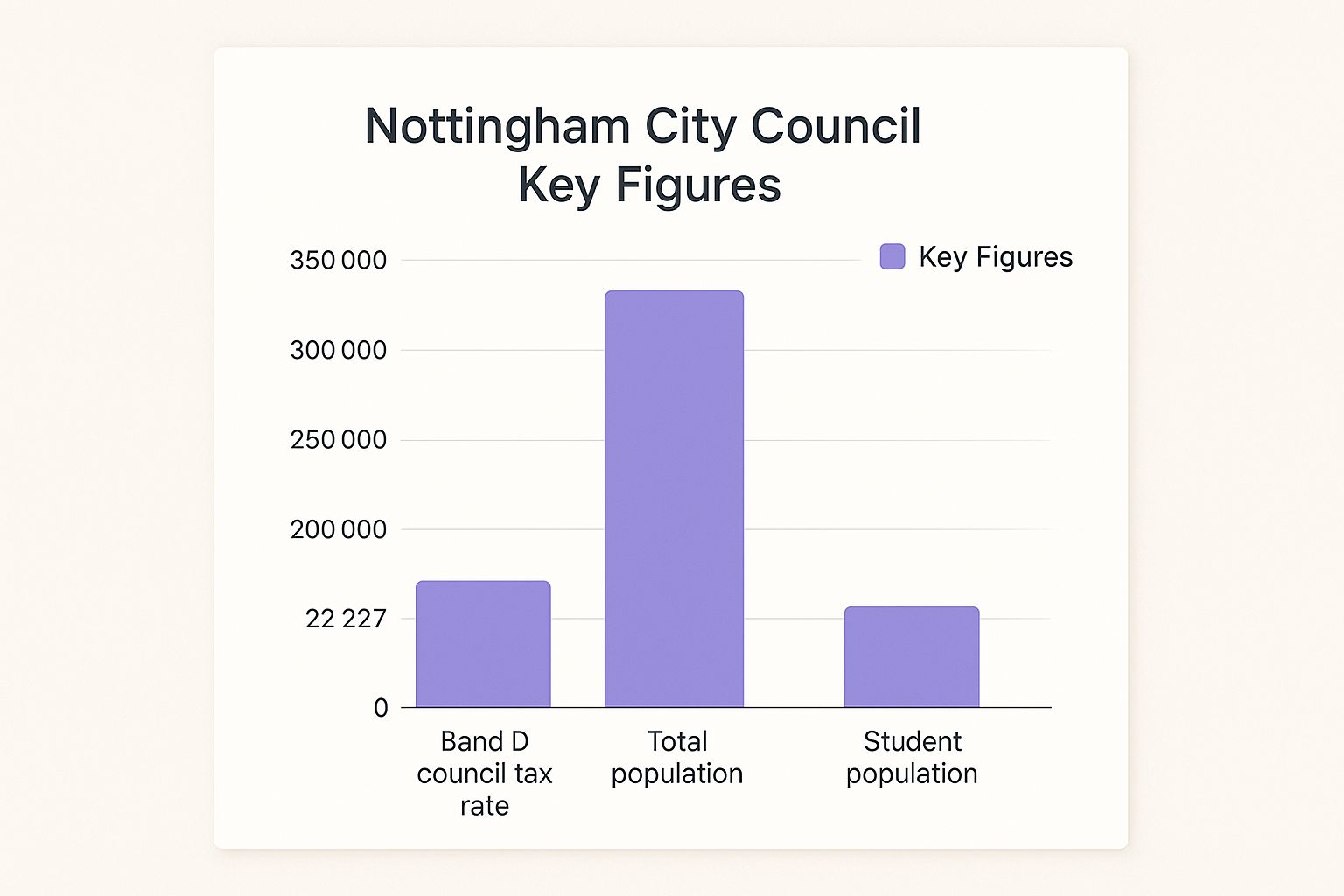
This bar chart highlights how the council must fund services for a large population, yet a substantial portion (the 60,000 students) are exempt from contributing to council tax. This dynamic places a heavier financial load on the remaining households, contributing to the higher individual bills seen across the city.
Why Is Nottingham’s Council Tax So High?
Nottingham's high tax rate is driven by a combination of high service demand and a relatively small tax base. The city has significant responsibilities for adult social care, children's services, and homelessness support, all of which are costly, high-demand services in urban environments. Compounding this, the city's large student population and areas of deprivation mean a smaller proportion of households pay the full council tax, requiring higher rates from those who do.
The council has attempted creative budgeting solutions, such as implementing the UK's first workplace parking levy in 2012, which generates millions for public transport. However, some commercial ventures, like the failed council-owned Robin Hood Energy company, have led to significant financial difficulties, putting further upward pressure on council tax to cover budget shortfalls.
Actionable Tips for Nottingham Residents
For those living in or moving to Nottingham, proactive management of this key household expense is essential. Consider the following tips to potentially lower your bill:
- Claim Student Exemptions: If you are a full-time student, or live in a property occupied solely by full-time students, you are exempt. Ensure you have applied for this exemption through the council's website.
- Apply for Council Tax Reduction: Residents on a low income can apply for the Council Tax Reduction scheme. Depending on your circumstances, you could receive a reduction of up to 91.5% on your bill.
- Check for Disability Reductions: The Disabled Band Reduction Scheme can lower your bill if your home has been adapted for a disabled resident. This effectively moves your property down one council tax band.
- Monitor Council Consultations: Keep an eye on the council's budget consultations. Participating can provide insight into spending priorities and offers a chance to voice your opinion on future tax and service decisions.
3. Dorset Council
Securing a spot among the areas with the most expensive council tax in UK is the relatively new Dorset Council. Formed in 2019 from a major merger of several district and county councils, this authority covers a vast and diverse rural and coastal region. For the 2024-25 period, the average Band D council tax bill was set at £2,454, reflecting the significant costs associated with delivering services across its wide-ranging geography.

Dorset’s high council tax is driven by a unique set of demographic and geographical challenges. The council serves an older population, with ONS data showing over 28% of residents are aged 65 and over, which places immense pressure on adult social care budgets. Furthermore, managing the iconic Jurassic Coast involves balancing the economic benefits of tourism with costly coastal erosion and conservation efforts. Delivering essential services to dispersed rural communities is inherently more expensive per household than in dense urban areas.
Why Is Dorset’s Council Tax So High?
Despite achieving significant savings since its creation by merging five councils into a single unitary authority, the underlying cost pressures remain. The authority has pioneered innovative solutions, such as integrated health and social care partnerships to support its elderly population more efficiently and rural community transport schemes that utilise volunteer drivers to connect isolated residents. These initiatives, while effective, must be funded by a tax base that is not as concentrated as in major cities.
The council’s budget must also account for seasonal demands from tourism, which increases the need for services like waste collection and public safety without a corresponding year-round increase in the number of council tax-paying households. This combination of a large land area, an older demographic, and high environmental management costs contributes to its position on this list. For a deeper understanding of Dorset's property market, you can explore the latest property data and trends.
Actionable Tips for Dorset Residents
For those living in or moving to Dorset, managing the high council tax bill is a key financial consideration. Here are some practical steps you can take:
- Check Pensioner Eligibility: There is no upper age limit for claiming Council Tax Support. Pensioners on a low income should check their eligibility, as they could receive a substantial reduction.
- Challenge Your Band (Rural Properties): If you live in a rural property, investigate the council tax bands of comparable properties in more urban parts of the council area. Discrepancies could form the basis of a challenge to the Valuation Office Agency (VOA).
- Single Person Discount: If you are the only adult living in your property, ensure you are claiming the 25% single person discount.
- Engage Locally: Attend your local parish or town council meetings. A portion of your council tax (the 'precept') is set at this level, and influencing local spending priorities can help ensure your money is used effectively in your immediate community.
4. Weymouth & Portland Borough Council (now part of Dorset Council)
Although it no longer exists as a standalone authority, the legacy of Weymouth & Portland Borough Council earns it a spot on this list. Before it was merged into the new Dorset Council in 2019, this coastal borough was consistently one of the areas with the most expensive council tax in UK. Residents in the area still face some of the highest rates within the wider Dorset region, a hangover from the unique financial pressures the former council faced.
The high costs were driven by a combination of factors specific to its coastal location. Maintaining extensive seafront infrastructure, including promenades and coastal defences, required significant ongoing investment. Furthermore, the council had to manage the impacts of seasonal tourism, which placed a strain on services like waste collection and public safety during peak months. Addressing pockets of deprivation in certain wards, highlighted in government indices, also demanded targeted funding, creating a challenging financial balancing act for a council with a relatively small population of around 65,000.
Why Was Weymouth & Portland’s Council Tax So High?
The borough's reliance on tourism created a volatile economic base, while the high costs of maintaining coastal assets were not matched by sufficient central government funding. Despite these challenges, the council delivered significant projects, including successfully hosting the sailing events for the London 2012 Olympics, which left a legacy of world-class facilities.
Innovative coastal defence schemes that combined environmental protection with robust engineering were implemented to protect the town. The council also forged successful partnerships with local businesses to manage and improve the seafront, demonstrating a proactive approach to its financial limitations. These historic spending commitments continue to influence the council tax precept for residents in the former borough area under the unified Dorset Council.
Actionable Tips for Residents in the Former Weymouth & Portland Area
If you live in this part of Dorset, understanding the local context can help you manage your household budget effectively.
- Check Coastal Premiums: If you own a seafront property, ensure your insurance and maintenance budgets account for coastal risks like flooding and erosion, as this can protect your property's value.
- Council Tax Reduction for Seasonal Work: If you are a seasonal worker, you may be eligible for Council Tax Reduction during periods of off-season unemployment. Check the Dorset Council website for eligibility criteria.
- Budget for Second Home Premiums: The government has given councils the power to charge a 100% premium on second homes. Dorset Council applies this, so owners of holiday homes must factor this significant extra cost into their annual expenses.
- Engage with Local Councillors: Voice your concerns about specific local issues, such as coastal management or service provision, to your elected Dorset Council representative to ensure your area’s needs are heard.
5. Bristol City Council
Securing a spot among the areas with the most expensive council tax in UK is Bristol City Council, particularly notable for its high rates within a major urban centre. As a vibrant and economically significant city, Bristol’s residents face substantial charges to fund its extensive public services. For the 2024-25 financial year, the average Band D council tax bill, including precepts, was approximately £2,530, placing it firmly in the upper tier for city councils.

The primary drivers for Bristol's high council tax are the immense pressures associated with a large, diverse urban population. The council serves over 479,000 residents according to ONS mid-year estimates, grappling with significant urban challenges such as high levels of homelessness, growing demand for children's social care, and the need for substantial infrastructure investment. Despite its dynamic economy, the council has experienced significant cuts in central government funding since 2010, forcing it to rely more heavily on council tax to maintain essential services.
Why Is Bristol’s Council Tax So High?
Bristol's position as a unitary authority for a major English city means it bears the full cost of a wide array of services that might be shared across different tiers of government elsewhere. This includes everything from waste management to adult social care, which is a major cost pressure for all councils. The city's popularity and growth also create demand for new schools, transport links, and housing, all of which require significant public investment funded partly through council tax.
To address these financial strains, the council has pursued innovative strategies. It was a pioneer in participatory budgeting, allowing residents to have a direct say on how local funds are spent. Furthermore, Bristol has become a leader in green initiatives, implementing a Clean Air Zone and investing heavily in cycling infrastructure as the UK's first 'Cycling City', demonstrating a commitment to long-term, sustainable urban development.
Actionable Tips for Bristol Residents
If you are a resident in Bristol, understanding how to manage your high council tax bill is essential. Several avenues for reduction and support are available:
- Check Student Status: Households occupied exclusively by full-time students are exempt from council tax. If you live in a mixed household, discounts may still apply.
- Apply for Council Tax Support: Low-income households can apply for Bristol's Council Tax Support scheme, which can provide a reduction of up to 100% depending on circumstances.
- Challenge Your Banding: Use the Valuation Office Agency (VOA) service to compare your property's band with similar homes in your area. If you find discrepancies, you may have grounds for an appeal.
- Disabled Band Reduction: If your home has been adapted to meet the needs of a disabled resident, you may be eligible to have your council tax band lowered by one tier.
- Spread Payments: Contact the council to arrange paying your bill over 12 monthly instalments instead of the standard 10. This can help ease cash flow throughout the year.
6. Lewes District Council (East Sussex)
Securing a spot on the list of the most expensive council tax in UK is Lewes District Council. Residents in this part of East Sussex face some of the highest bills in the country, with the combined Band D charge for 2024-25 reaching over £2,450 when including precepts from East Sussex County Council, police, and fire services. This figure places significant financial pressure on the district's 103,000 residents.
The high costs in Lewes are driven by a unique combination of geographic and demographic factors. The council must manage the considerable expense of protecting its coastline from erosion, particularly around towns like Newhaven and Seaford. It also funds services across a dispersed population, from historic market towns like Lewes to smaller rural villages, which increases the per-household cost of delivery for essential services such as waste collection and infrastructure maintenance.
Why Is Lewes’s Council Tax So High?
A key driver of Lewes's high council tax is the cost of managing both its natural and built environment. The council has invested millions in successful flood defence schemes to protect its communities. Furthermore, maintaining the historic character of its towns requires specialised conservation efforts, adding another layer of expense. Despite these challenges, the council has pioneered several innovative community-led housing projects to deliver much-needed affordable homes.
To balance its budget, the council has developed award-winning recycling programmes with high participation rates and launched green energy initiatives, including solar panel schemes, to generate income and reduce its carbon footprint. These forward-thinking measures are designed to mitigate the financial burden while continuing to deliver vital local services.
Actionable Tips for Lewes Residents
For homeowners and prospective buyers in the Lewes district, understanding how to manage this high outgoing is essential.
- Check Your Banding: Many historic properties in the area could be in an incorrect council tax band. A quick check on the Valuation Office Agency (VOA) website could lead to a reassessment and substantial savings.
- Apply for Support: Lewes District Council administers the Council Tax Support scheme for those on a low income or receiving benefits, which can reduce your bill.
- Claim Discounts: Ensure you are claiming all eligible discounts. A 25% single person discount is the most common, but reductions are also available for properties adapted for a disabled resident.
- Review Exemptions: You may be eligible for an exemption if, for example, your property is undergoing major structural work or if an annexe is occupied by a dependent relative.
Thoroughly investigating these avenues can help offset the financial impact. For a deeper dive into evaluating property costs, you can explore our guide on how to conduct comprehensive property research.
7. Guildford Borough Council (Surrey)
Situated in the affluent county of Surrey, Guildford Borough Council represents another area where residents face some of the most expensive council tax in UK. The high cost here is a two-tier issue, driven by the combined charges from both the borough and the significantly more expensive Surrey County Council. For the 2024-25 period, the total Band D bill for many residents in the borough exceeded £2,370, reflecting the high cost of delivering services in one of England's wealthiest home counties.
The primary driver for these high bills is the cost structure of Surrey County Council, which is responsible for big-ticket items like adult social care, education, and transport infrastructure. Serving a population of around 150,000, Guildford's own council must also fund high-quality local services, such as award-winning park management and complex town centre regeneration projects. High property values, with Zoopla data showing an average sold price over £600,000, do not directly translate into proportionally higher council tax revenue due to the cap at Band H, meaning the burden is spread more evenly across all properties while resident expectations for premium services remain exceptionally high.
Why Is Guildford’s Council Tax So High?
Guildford's financial landscape is dominated by the spending of Surrey County Council, one of England's priciest upper-tier authorities. The county faces immense pressure, particularly in funding innovative adult social care models for an ageing population. This financial strain is passed down to residents via its precept, which makes up the largest portion of the final bill.
At a local level, Guildford Borough Council invests heavily in maintaining its status as a desirable place to live. This includes managing complex traffic systems in its historic town centre and forging effective partnerships with institutions like the University of Surrey on community initiatives. These projects, while beneficial, require significant funding that is ultimately sourced from council tax payers.
Actionable Tips for Guildford Residents
Living in Guildford requires careful financial planning, but there are ways to manage the high council tax liability:
- Check Precepts Carefully: When choosing a location within the borough, pay close attention to parish council precepts, as these can add a further layer of cost to your annual bill.
- Engage with Consultations: Both the borough and county councils hold public consultations on their budgets. Engaging with these provides an opportunity to influence spending priorities that directly affect your bill.
- Explore Support Schemes: Despite the area's affluence, a Council Tax Support scheme is available for residents on lower incomes. Don’t assume you are not eligible; check the criteria on the council's website.
- Monitor County Finances: A significant portion of your bill is determined by Surrey County Council. Keep an eye on its financial stability and budget announcements, as these are the biggest indicators of future council tax rises.
Top 7 UK Councils by Council Tax Rates Comparison
| Council Authority | Implementation Complexity 🔄 | Resource Requirements ⚡ | Expected Outcomes 📊 | Ideal Use Cases 💡 | Key Advantages ⭐ |
|---|---|---|---|---|---|
| Rutland County Council | Moderate - small unitary authority managing rural services | High per capita due to small population and limited tax base | High-quality local services but costly for residents | Rural communities with small populations needing tailored support | Strong community engagement; well-maintained rural services |
| Nottingham City Council | High - urban unitary authority with complex social and infrastructure needs | Very high, managing diverse social care and urban infrastructure | Comprehensive urban services, but financial distress present | Large urban areas with high social care and infrastructure demands | Innovative transport funding (parking levy); strong social support |
| Dorset Council | High - large rural unitary authority with aging population and coastal challenges | Substantial due to geography, aging demographics, and tourism impacts | Balanced rural services with focus on elderly care and coastal management | Large rural/coastal areas facing demographic and environmental pressures | Integrated elderly care partnerships; tourism management innovation |
| Weymouth & Portland Borough Council | Moderate - former borough with coastal maintenance and seasonal economy | High for seafront upkeep and seasonal service demands | Coastal and community services sustained despite high costs | Coastal towns with seasonal tourism and mixed economies | Strong community pride; Olympic legacy facilities |
| Bristol City Council | Very High - major city with significant social and infrastructure challenges | Very high resource demand for homelessness, children’s services, and regeneration | Maintaining urban services with funding pressures and growth needs | Major cities requiring sustainable urban and social investment | Pioneering participatory budgeting; sustainable transport leadership |
| Lewes District Council (East Sussex) | High - two-tier system with rural/coastal complexity | High due to flood defense costs and dispersed population | Preserved historic environment alongside essential rural services | Rural and historic districts with flood risks and two-tier governance | Award-winning recycling; effective flood defenses |
| Guildford Borough Council (Surrey) | Moderate-High - two-tier affluent commuter area with high service expectations | High combined tax due to county and borough service demands | High-quality services with financial strain on county council | Affluent commuter regions with two-tier local government | Outstanding education; nationally recognized green spaces |
Making Smart Decisions in High Council tax Areas
Navigating the UK property market requires a keen eye for detail, and as this analysis has shown, council tax is far more than a minor administrative fee. It represents a significant, non-negotiable annual expense that directly impacts a property's overall affordability and investment viability. Our journey through the areas with the most expensive council tax in UK has revealed a complex tapestry of local governance, demographic needs, and economic realities.
We've seen how Rutland’s vast rural landscape and Nottingham’s urban density create unique funding pressures. We've explored how affluent areas like Guildford and Lewes balance high service expectations with their tax base, and how councils like Dorset consolidate resources to manage extensive coastlines and diverse communities. The key takeaway is that high council tax is not arbitrary; it's a calculated figure reflecting the real-world cost of maintaining and improving local infrastructure, from social care and education to waste collection and emergency services.
Key Takeaways for Homebuyers and Investors
For prospective homebuyers, particularly first-time buyers, factoring in council tax from day one is non-negotiable. A higher band can add hundreds of pounds to monthly outgoings, potentially affecting mortgage affordability calculations. Investors, meanwhile, must meticulously incorporate this expense into their yield calculations. A high-yielding rental property can quickly become a marginal investment if the council tax bill erodes a significant portion of the rental income.
The disparities between neighbouring authorities underscore the importance of hyper-local research. As we've seen, a property in one postcode can have a substantially different cost profile to another just a few miles away under a different council's jurisdiction.
Actionable Next Steps for Your Property Search
To move forward with confidence, you must integrate council tax analysis into your core property evaluation strategy. Here’s how:
- Look Beyond the Asking Price: Always treat council tax as a primary running cost, alongside mortgage payments and utility bills. Use the official government website to check the council tax band of any property you are seriously considering.
- Analyse the 'Why': Don't just look at the cost; investigate the services it funds. High council tax might correlate with excellent local schools, well-maintained parks, and superior public services, which can enhance property value and quality of life over the long term.
- Budget for Future Rises: Council tax rates are not static. Factor in potential annual increases, which are often capped by central government but can still impact your budget over time.
Ultimately, understanding the nuances of the UK’s most expensive council tax areas transforms you from a passive house-hunter into a strategic property analyst. By arming yourself with detailed, location-specific data, you can make informed decisions that align with your financial goals, ensuring your next property move is not only successful but also sustainable for years to come.
Ready to turn data into decisive action? Property Insights provides the granular, postcode-level data you need to accurately forecast outgoings, including council tax rates, and compare investment opportunities across the UK. Visit Property Insights to equip yourself with the tools to navigate high-cost areas and secure your next property with complete financial clarity.
Property data, one integration
Build with UK property data
Browse our APIs for valuations, sold prices, EPCs, crime, schools, ownership and more.