Estate Agent Prospecting Packs Using Property Data APIs
Plan a branded estate agent prospecting pack with valuation evidence, EPC, Council Tax and local data, then automate it without losing human review.

Most estate agency prospecting material says more about the agency than the property owner. A generic leaflet may establish local presence, but it gives the recipient little reason to keep it. A property-specific pack can be more useful because it starts with information about the home: recent sales, an indicative valuation range, energy data, Council Tax context and a clear explanation of what the agent would check in person.
The best estate agent prospecting packs do not pretend an automated report is a valuation appointment. They turn available data into a relevant first conversation and leave space for an agent's local judgement.
What a prospecting pack should achieve
A prospecting pack can support several stages of an agency relationship:
- Give a homeowner a reason to respond to a letter or email.
- Prepare a valuer before an appointment.
- Follow up an online valuation enquiry with useful evidence.
- Re-engage an old lead when local market activity changes.
- Explain a proposed asking-price range after an inspection.
- Keep the branch's contact details and next step easy to find.
It should not bury the reader in raw data. Every section needs a purpose. If a map, chart or statistic does not help the homeowner understand the property, local market or next step, leave it out.
The report should also say when the information was retrieved. Property data changes at different speeds, and a recipient may open the PDF weeks after it was produced.
Prospecting pack, market appraisal and sales pack
These terms should not be used interchangeably.
Prospecting pack
A marketing and preparation document intended to start or support a relationship. It may use public and modelled property data, agency branding and a call to arrange an appraisal.
Market appraisal
An estate agent's opinion of likely marketing and sale price, informed by property inspection, local competition, buyer demand and comparable evidence. Its purpose and limitations should be clear.
Sales pack or material information
Upfront information for buyers and transaction professionals has a different legal and operational purpose. The current GOV.UK home buying and selling reform roadmap supports greater use of upfront sales information, while detailed requirements continue to develop.
A prospecting PDF does not become a legal sales pack because it contains an EPC rating or boundary image. It is not a title report, property information form, search, condition report or survey. Keep that distinction explicit.
Recommended sections
Property identity
Open with the complete property address, the report date and a photograph only where the agency has a lawful right to use it. Confirm the address before generating the pack, especially for flats and converted buildings.
Indicative valuation range
Show a modelled range and confidence rather than one oversized number. Explain that condition, improvements and current demand require an in-person appraisal.
Recent sold evidence
Choose a small set of relevant comparable sales. Include sold price, date, property type and why the sale is useful. A nearby but dissimilar transaction should not be included simply to increase the page count.
Market context
Use a short local trend or HPI section to place older evidence in context. Avoid predictions presented as fact.
EPC and floor area
Show the latest relevant certificate's rating, date and recorded floor area. Do not describe an old EPC measurement as a current survey.
Council Tax
Include the property-level band and standard authority rate where confirmed. State the tax year and note that discounts or premiums can alter the household bill.
Local information
Schools, crime and connectivity may be useful, but only when sourced and neutrally presented. Avoid subjective claims such as "safe area" based on one statistic.
Agent commentary and next step
This is where the report becomes more than a data export. Add a short, reviewed note about the property and a specific invitation to book an appraisal or discuss the evidence.
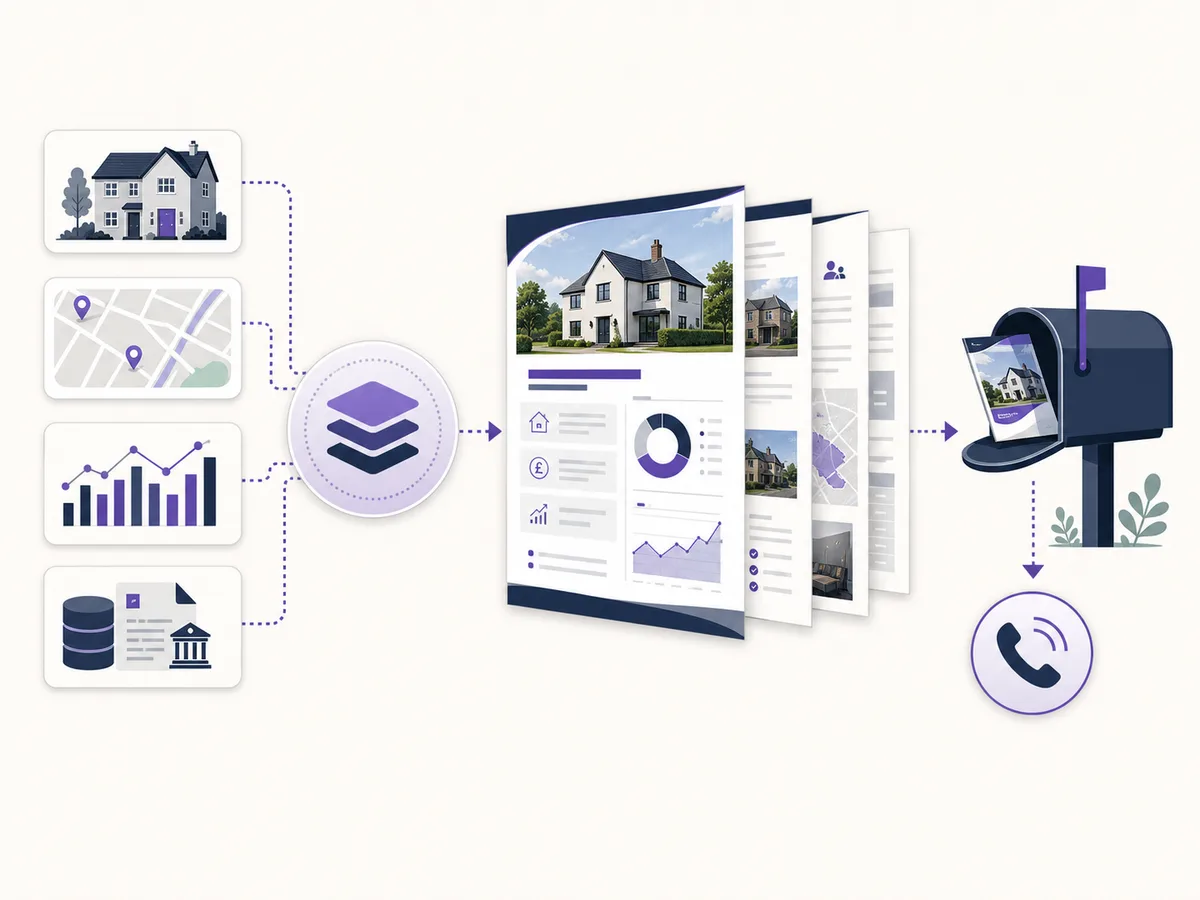
Automation can gather and lay out evidence, while the agent reviews the property match and customer-facing commentary.
Personalisation that earns its place
Personalisation should improve relevance, not merely repeat the recipient's name throughout the document.
Useful fields include:
- Branch and valuer contact details.
- Recipient or organisation name on the cover, where lawfully held.
- Confirmed property address.
- Local comparable selection.
- A note linked to the homeowner's enquiry or appointment.
- One clear call to action.
Avoid behavioural claims that cannot be supported, such as "buyers are waiting for your exact home". If the branch has registered applicants with appropriate requirements, the agent can explain that in a reviewed note rather than relying on boilerplate.
Keep branding restrained. A logo, branch colours and contact details are enough. Oversized promotional panels make the evidence feel less credible.
A practical automated workflow
The Property Information Pack API can turn a confirmed property and selected scenarios into a private branded PDF.
A sensible prospecting workflow is:
- Capture the property address through an enquiry, CRM record or approved prospect list.
- Resolve and confirm the address or UPRN.
- Retrieve property and local data.
- Generate a draft pack using the branch brand profile.
- Flag missing sections and low-confidence valuation evidence.
- Ask the assigned agent to review the address, comparables, estimate and copy.
- Approve the pack for the chosen channel.
- Record when and why it was sent.
- Measure the reply, appointment or instruction, not only the PDF open.
Do not automatically send every generated result. A wrong flat, missing comparable set or unexpectedly low confidence should pause the workflow.
Where human review matters
Automation is good at gathering repeatable fields, applying a layout and producing consistent source notes. An agent adds information that APIs may not know:
- Current condition and presentation.
- Extensions, conversions or repairs.
- Plot quality, outlook and parking.
- Competing listings and active buyer feedback.
- The seller's timing and priorities.
- Whether a particular comparable really belongs in the set.
Create a review screen that shows warnings before the PDF is approved. The reviewer should be able to exclude a comparable with a reason, add a concise note and regenerate the pack without changing the source record.
The process also needs ownership. Record which user approved the pack and which data version or retrieval date it used.
Prospecting, follow-up and appraisal uses
Targeted letters
A short letter can introduce the specific report and provide a private link or printed summary. Ensure the underlying prospecting activity complies with data-protection and direct-marketing rules.
Online valuation follow-up
After a homeowner requests an estimate, send the pack as a more useful explanation than a single automated number. Make the next step an appointment to review condition and local demand.
Appointment preparation
Generate the pack for the valuer before the visit. They can review sold evidence, note questionable matches and arrive with a structured starting point.
Post-appointment report
After inspection, update the agent commentary and selected comparables. Keep the original automated estimate separate from the agent's final market-appraisal opinion.
Dormant lead re-engagement
Regenerate only when there is a genuine reason, such as new comparable evidence or a requested update. Repeatedly sending near-identical reports can damage trust and create marketing-compliance risk.

The report supports the conversation; inspection and local judgement still shape the appraisal.
Privacy, direct marketing and retention
Property data may be public while the relationship between a person and an address is personal data. A pack workflow needs a lawful basis, clear purpose, suppression handling and a retention policy.
Practical controls include:
- Keep API keys and generated private PDFs on the server.
- Limit access to the assigned branch or authorised staff.
- Avoid embedding unnecessary personal data in filenames.
- Use expiring authenticated downloads for private reports.
- Record consent or legitimate-interest decisions where applicable.
- Honour opt-outs across letter, email and calling workflows.
- Delete expired reports according to the stated retention period.
- Do not upload customer lists to unrelated generation tools.
Take legal advice for the agency's specific prospecting model. An API implementation cannot decide the lawful basis for the business.
Measuring commercial value
PDF generation volume is an operational metric, not a business outcome. Track the journey:
- Packs generated.
- Packs approved.
- Delivery success.
- Meaningful views where consented analytics permits it.
- Replies or calls.
- Appraisals booked.
- Instructions won.
- Time from enquiry to contact.
- Opt-outs and complaints.
Compare reviewed packs with the prior follow-up process. If generation increases but appointments do not, inspect the audience, message, evidence quality and next step before adding more pages.
Prospecting pack checklist
- Confirm the exact property before requesting data.
- Keep prospecting, appraisal and legal sales-pack purposes separate.
- Show valuation range, confidence and date.
- Use a small, explained comparable set.
- Display source dates for EPC and Council Tax.
- Give the assigned agent a review step.
- Use restrained branding and one clear CTA.
- Protect private PDFs and credentials.
- Record why and when the pack was sent.
- Measure appointments and instructions, not generation alone.
Frequently asked questions
Is a prospecting pack a formal valuation?
No. It can include an automated estimate and comparable evidence, but a formal valuation or agent appraisal has a different process and purpose.
Is it the same as a legal sales pack?
No. A marketing or appraisal-support report does not replace property forms, searches, title work, a condition report or other required transaction information.
Should every pack be reviewed by an agent?
Yes, before customer-facing use. At minimum, confirm the property, estimate, comparables, missing sections and contact copy.
Which data makes the pack useful?
Start with identity, valuation range, selected sold evidence, market context, EPC and Council Tax. Add local sections only when they help the recipient's decision.
How often should a lead receive an updated pack?
Only when the recipient requests it or meaningful evidence has changed. Use normal marketing preferences and suppression rules.
To test the workflow, create one reviewed report for a fictional property in the information-pack interface, then compare it with the branch's current appraisal follow-up before automating delivery.
Property data, one integration
Build with UK property data
Browse our APIs for valuations, sold prices, EPCs, crime, schools, ownership and more.